A Multidisciplinary Curriculum
Our Master in Aerospace Engineering (MAE) equips students with the advanced knowledge and practical skills needed to address complex challenges in product and system design, as well as operational strategies within both research institutions and aerospace companies.
Majors of Specialisation
The programme offers 7 majors of specialisation allowing students to chose their academic journey to align with their individual interests and professional goals.
Aircraft Design and Operation Pathway
Students in the Aerospace Structures, Aerospace Systems & Control, and Systems Engineering majors can follow the Aircraft Design and Operation pathway.
This pathway allows students to follow two dedicated modules: Aircraft Design Methods and Multidisciplinary Optimization, and they conduct their Research Project in this field.
Programme Objectives
- Objective 1: to master sound technical and scientific skills in the main disciplines related to aerospace engineering
- Objective 2: to be aware of the key disciplines that play a major role in new aerospace projects
- Objective: to develop a comprehensive, interdisciplinary approach to the design and development process of a product or system
- Objective: to prepare students to work and communicate in multicultural environments, oriented towards teamwork and innovation. French courses are compulsory for beginners during both years of the programme.
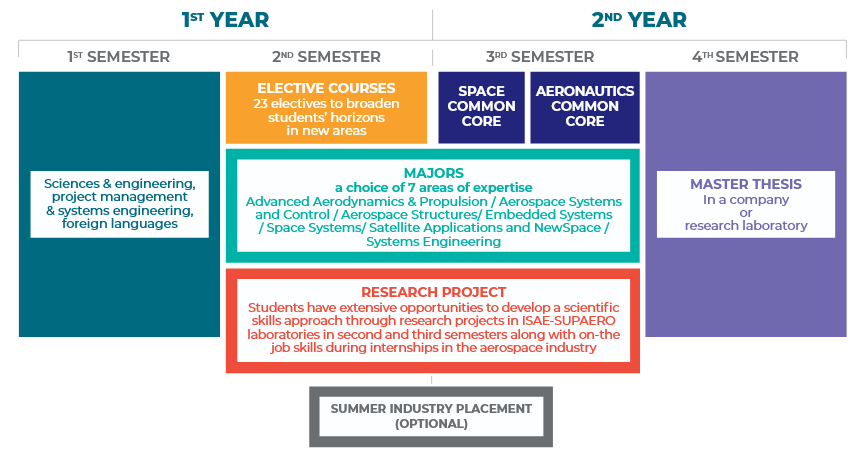
Semester 1
- A rich multidisciplinary core curriculum in science, engineering, and project management
- Foreign languages: French, Spanish, German, Russian, Chinese, etc.
Semester 2
- A core curriculum
- More than 20 electives covering the main areas of aerospace engineering
- A research project in semesters 2 and 3
- Foreign languages: French, Spanish, German, Russian, Chinese, etc.
Semester 3
- 7 majors of expertise directly linked to the needs of the aerospace industry and research:
- Advanced Aerodynamics and Propulsion
- Aerospace Structures
- Aerospace Systems and Controls
- Embedded Systems
- Space Systems
- Systems Engineering
- Satellite Applications and NewSpace.
- A research project spread over semesters 2 and 3
- Foreign languages: French, Spanish, German, Russian, Chinese, etc.
Semester 4
- A four to six-month end-of-studies internship in either industry or a research laboratory
The 7 Majors
- Advanced Aerodynamics
- Fluid and Structure Interactions
- Advanced Aerodynamics of
- Turbomachinery
- Numerical Fluid Mechanics
- Aeroacoustics
- Physics and Modelling Turbulence
- Multiphase Flow and Combustion
- Multiple Input and Output Systems
- Control of Flexible Structures
- Robust and Optimal Control
- System Identification and Estimation
- Nonlinear Control
- Hybrid Control
- AI Methods and Tools for Automatic Control
- Power Systems and Aerospace Architecture
- Aerospace Actuation Systems - Preliminary Design
- Modelling and Sizing of Aircraft Air Conditioning Systems
- Aeroelasticity and Flexible Aircraft - Aeroelasticity Section
- Aeroelasticity and Flexible Aircraft - Flexible Aircraft Section
- Aerospace Structures - Advanced Structural Dynamics
- Aerospace Structures - Composite Structures in Services
- Computational Solid Mechanics
- Manufacturing
- Mechanics of Materials
- Space Structures: Spacecraft and Launchers
- High-level Formal programming Languages
- Real-Time Systems
- Model-Based System Engineering
- Real-Time Networks
- AI and Autonomous Systems
- Architecture, Design and Synthesis of Hardware Systems
- Architecture, Design and Synthesis of Hardware Systems
- UPGRADE - Systems Dependability (SD)
- Certification
- Satellite Flight Software 20
- Space Environment and Effects
- Mission Analysis and Orbital Mechanics
- Space Sommunications Systems
- Space Project: Simulation Tools
- Space Systems Architecture: Ground Segments,
Satellites and Suborbital Aircraft - Launch Vehicle Architecture
- Satellite Propulsion: Chemical and Electrical
- Satellite AOCS
- Launch Vehicle Guidance and Control
- Satellite Electrical Systems
- Onboard Data Processing Subsystems: Functions and Architectures
- Satellite Thermal Control Systems
- Estimation and Filtering
- Space Environment and Effects
- Mission Analysis and Orbital Mechanics
- Space Systems
- Random Signal Processing and Estimation
- Wireless Transmission Techniques
- Software Defined Radio
- Machine Learning for Communications
- Constellations and Mobile Services
- Satellite Navigation
- Requirements Engineering (RE)
- Systems Engineering Data Technical Management (SEDTM)
- Systems Modelling and Analysis (SMA)
- Systems Dependability (SD) - SEN part
- Systems Dependability (SD)
- Systems Design and Architecture (SDA)
- Introduction to Verification & Validation (IVV)
- AIRBUS Case Study: Systems Engineering &
- Certification of the A350 (A350)
- Systems Engineering Methods and Tools (SEMT) –
Space Track or Aero Track